

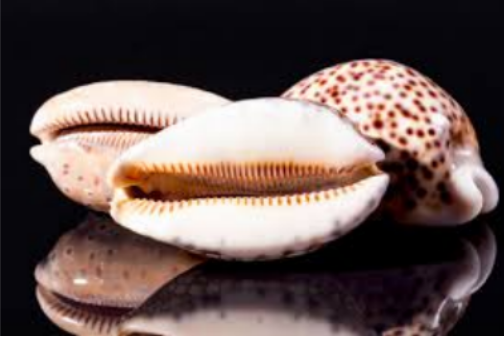
U.S. Supreme Court Justice Ketanji Brown Jackson made a powerful statement at the second Trump inauguration, not with words but adornment! Instead of a traditional jabot, she wore a striking necklace of cascading cowrie shells, stark white against her black judicial robe, like a warrior’s breastplate.
She was armored up, and it caused a viral sensation.

A jabot (pronounced zha BOH) is an 18th-century accoutrement to the front of a blouse or shirt. The first woman on the Supreme Court, Justice Sandra Day O’Connor’s jabots were lacy or pleated fabric accents that became her signature.
The late Justice Ruth Bader Ginsburg took hers to a whole ‘nother level. The Notorious RBG had an array of crocheted, beaded and bejeweled collars, with special ones worn when she was presenting dissenting opinions to the Court. She wore one of those to the Court the day after Trump’s first inauguration.
The chattering political class has had problems with clothing on certain people in the past. President Obama caused an uproar over a tan suit. First Lady Michelle Obama discovered she did not have the right to “bare” arms when she went sleeveless at a public event. Apparently some folks felt her gun show needed some serious holstering.
The comments on Justice Jackson’s sartorial choice ranged from “fashion faux pas’” “improper” and “superstitious,” to “ceremonial,” “significant” and a “brilliant interpretation through an African American cultural lens.”
Cowrie shells have had pride of place in African culture for thousands of years as currency, in spiritual rituals and as art. Their use has been found in such disparate places as pre-dynastic Egypt, Neolithic Southern Levant (modern day Palestine, Israel and Jordan) and Tibet.
In India they are part of cremation rituals. In fact, the word cowrie comes from Hindi, which is itself derived from Sanskrit, the scriptural language of Hinduism.
The classical Chinese character for money originated as a stylized drawing of a cowrie shell. The Ghanaian cedi (currency) was named after cowries. The indigenous Ojibwe of North America use cowries in their Grand Medicine rituals. Because of their resemblance to the female anatomy, cowries represent womanhood, fertility and birth.
My first trip to Cuba in the 90s was with a group of sister-friends to attend an international conference on African Spirituality. One day at lunch we met a Babalawo, a Yoruba word meaning “father of secrets,” a high priest in the Ifa West African divination system.
His name was Kike (Kee-KAY). He was tall, good looking, exuberant, friendly, and a passionate advocate for his faith. He generously invited us to his home to meet his wife, Caridad. We shared food, played music, danced and laughed. Then he offered to give us each a spiritual reading.
My reading was last. Kike and his godson threw the cowrie shells and peered at them, whispering feverishly with each other in Spanish. Then he said my late husband was there and described how he’d died, without me even mentioning I’d been married. He conveyed that my husband had unfinished business, that there were some simple rituals I needed to complete, and he gave me instructions on how to do it.
Kike’s manner was so warm, sure, sincere and respectful that I felt no fear, only reassurance and support. Being able to fulfill the tasks gave me a sense of re-connection with my husband, gratified that I could help him one more time.
Cowrie shells, like Celtic runes and Chinese I Ching coins, are portals, conduits or keys for the person using them to unlock her or his own understanding. I am not saying that Justice Jackson’s cowrie shell necklace had any spiritual, dangerous, subversive or protective portent. But I am saying it made me damn proud to see her wearing it.
“You subjugate a people by telling them that their science is superstition, their faith is heresy and their wisdom is make-believe… But those superstitions are, in fact, tributaries leading to rivers and oceans of truth about what we really are, and who we might have been.”
— Bad Hair, 2020, written and directed by Justin Simien.
I know the practices and artifacts of non-Western traditions may appear or are interpreted as superstition or even heresy. But it is imperative that we hold fast to the respect for our own cultural customs even as we navigate the modern world.
Because proclaiming one’s own worldview out loud, despite the cacophony of dominant, competing and threatening paradigms, and expressing it by our own music, art, dance, writings, hairstyles, clothing and adornment is part of how we not only resist, we persist; not just survive, but thrive.
Until we meet again,
Warmly,
Isisara Bey